



Cohousing: creating the neighbourhoods we need
12.10.26
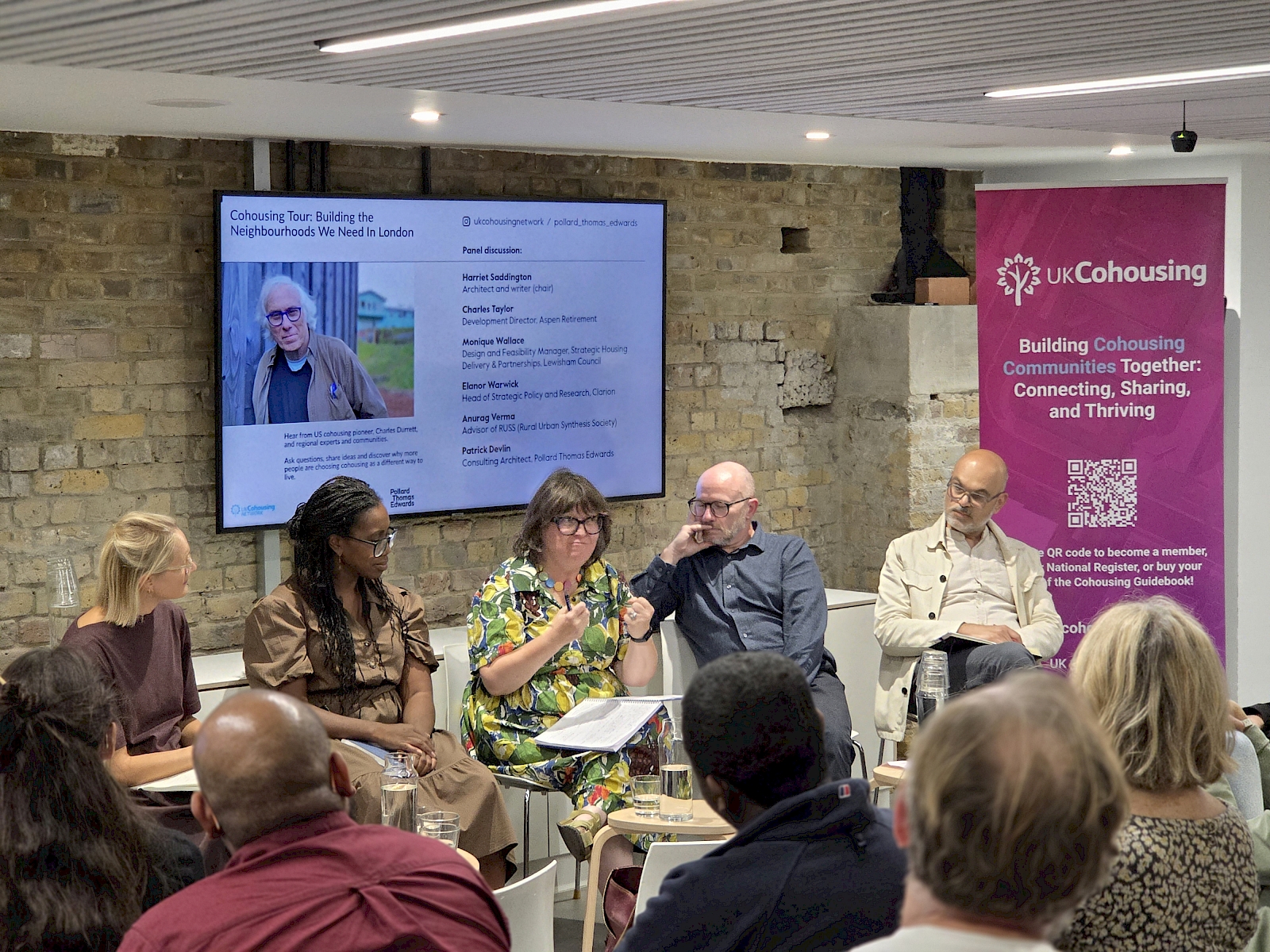
How can cohousing move beyond a handful of pioneering projects and become a more established part of housing delivery in London and across the UK?
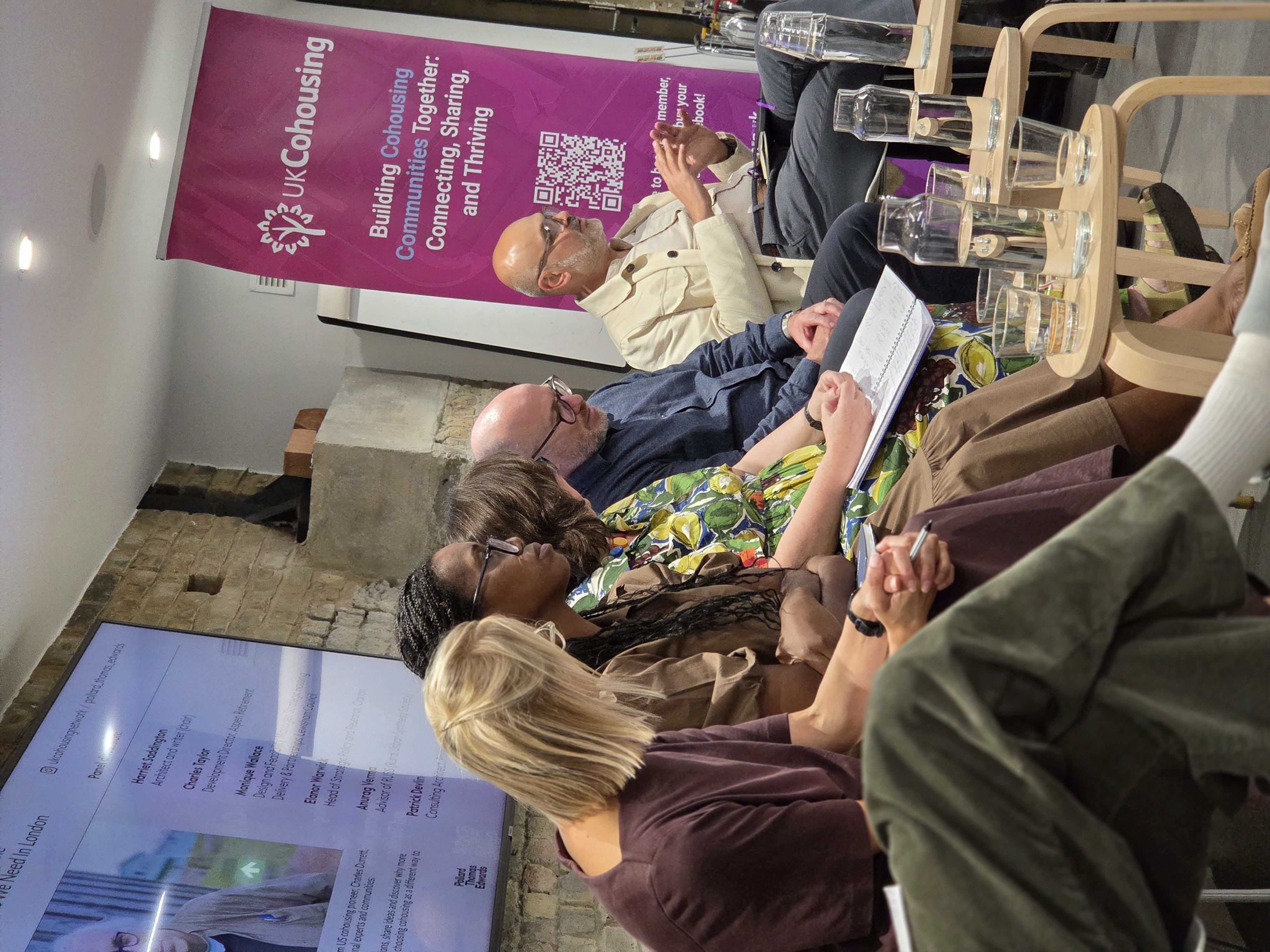
That was the central question at Cohousing: Building the Neighbourhoods We Need in London, hosted by Pollard Thomas Edwards and the UK Cohousing Network on 1 October. The evening brought together housing professionals, policymakers, developers, architects, community leaders and residents to examine how cohousing could support affordability, healthy ageing, social connection, community resilience and long-term neighbourhood stewardship.
Introducing the event, Owen Jarvis of the UK Cohousing Network highlighted the growing momentum behind the movement. There are now 25 established cohousing communities across the UK, with further schemes in development and a national waiting list of more than 3,000 people seeking opportunities to join one. He also pointed to growing policy interest in community-led housing as evidence that cohousing is becoming an increasingly relevant part of the wider housing conversation.
From individual homes to functioning neighbourhoods
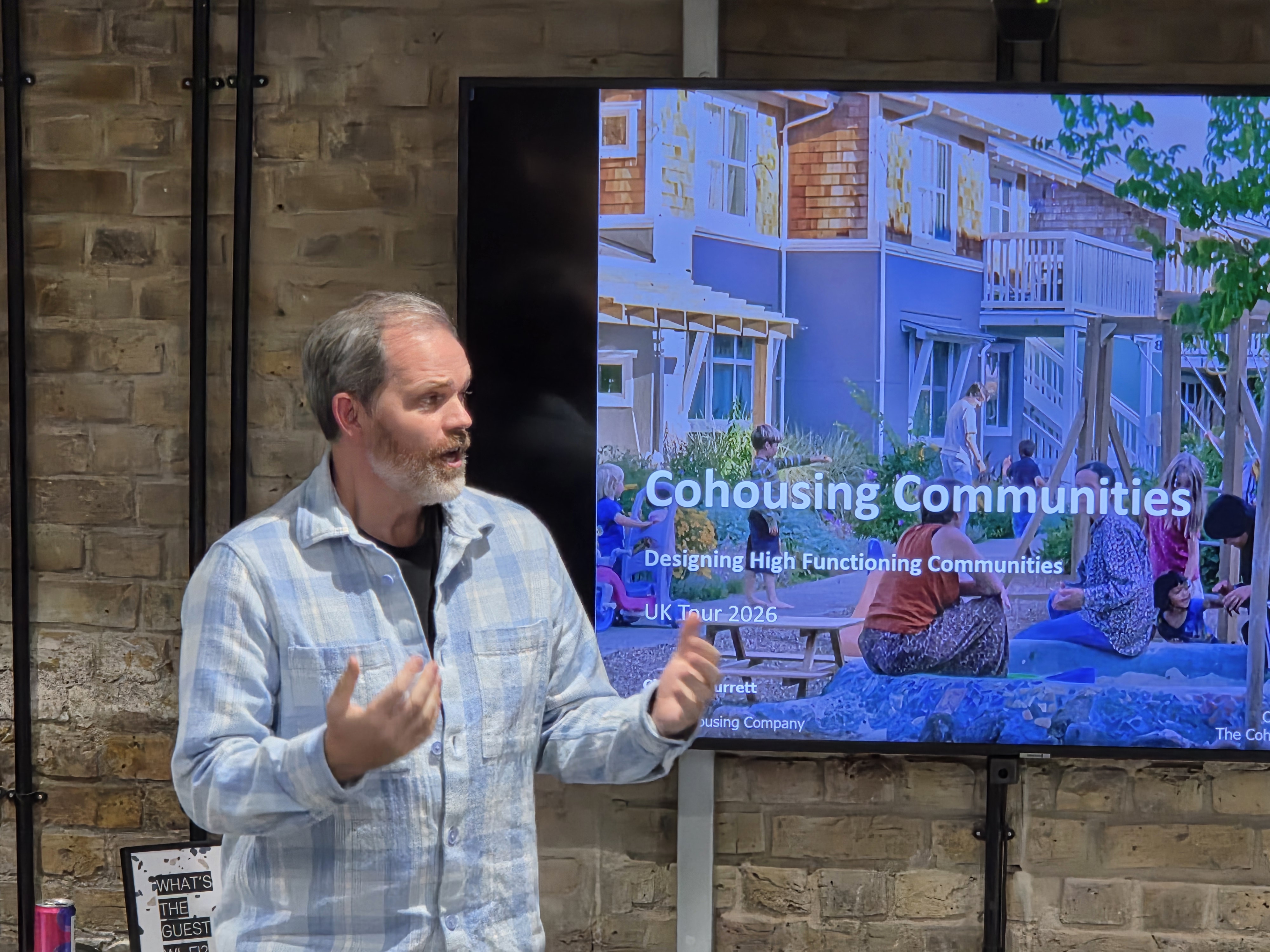
The keynote address came from cohousing pioneer Charles Durrett, whose four decades of international experience have included the design of more than 55 cohousing communities.
Drawing on examples from the United States, Denmark and elsewhere, Durrett argued that successful cohousing begins not with a predetermined architectural solution, but with residents collectively establishing the culture and life they want to create.
“We built it, not brick by brick, but decision by decision.”
For Durrett, participation is not simply a consultation exercise. Future residents help define the goals, activities and spaces around which their neighbourhood will be designed. This produces better-informed decisions, while giving the community the emotional ownership and determination required to carry a project through planning, financing and construction.
“It’s not just their input and their data that I need. I need them to own it emotionally.”
His approach begins with three questions: who are we as a culture, who do we want to become, and how do we get there? The physical design follows from those conversations. As he put it: “If it doesn’t work socially, why bother?”
This has practical implications for everything from the location of the common house and the width of pathways to acoustics, natural light, front porches and the view from a kitchen sink. These seemingly modest decisions can create regular, informal opportunities for neighbours to meet without sacrificing the privacy of their own homes. Durrett referred to these as moments of "spontaneous socialisation" - everyday encounters shaped by design that help counter the growing tendency for social interaction to move online. They can also encourage intergenerational relationships, bringing together people who might not otherwise meet. In one project, he observed how a simple billiards room became a natural gathering place for younger and older residents alike, helping to build a stronger sense of community.
"Basic cohousing maths is one plus one equals three. I have an idea, you have an idea, and together we talk until we have a third idea. Which of course will be better."
Making cohousing deliverable
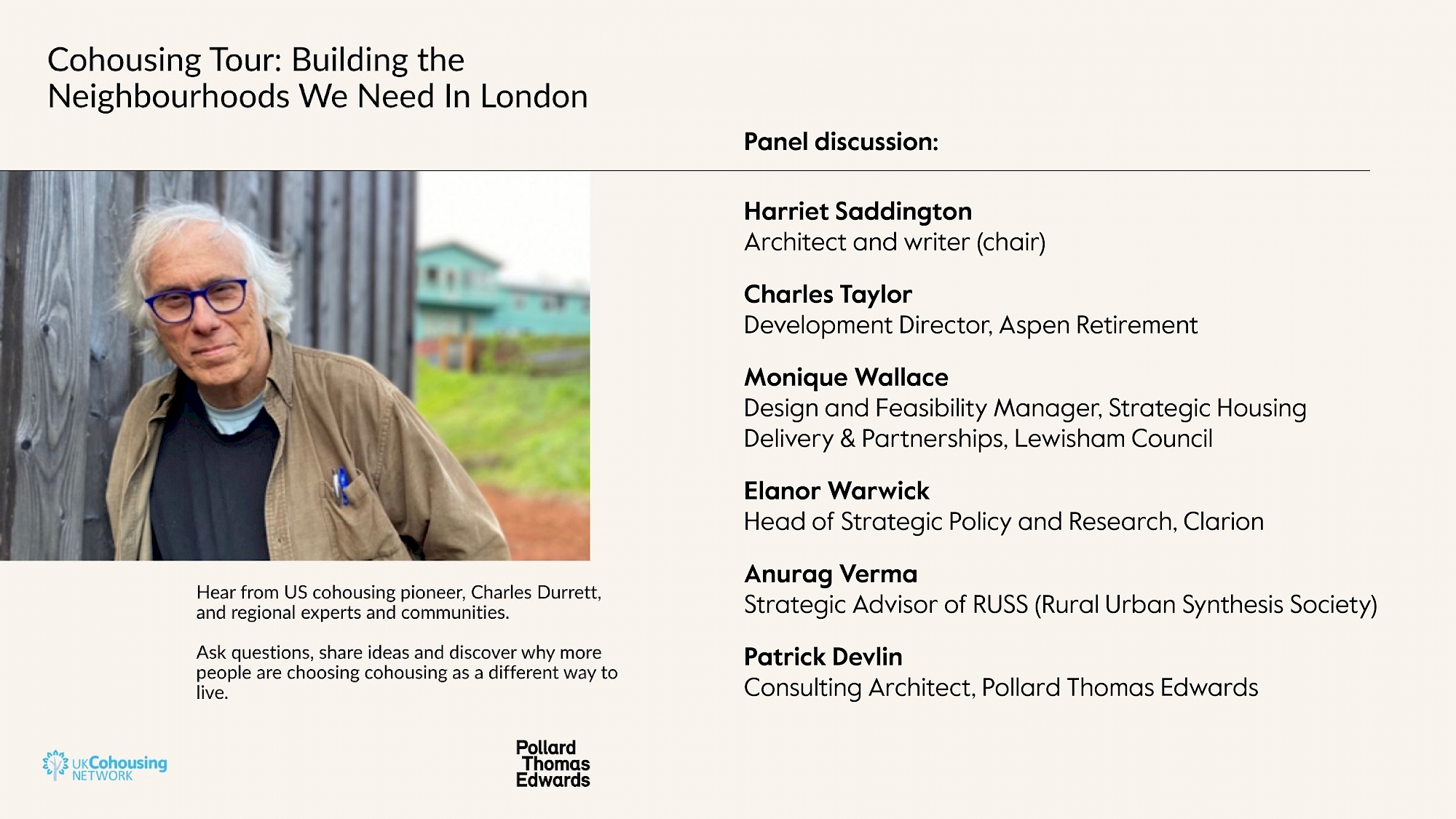
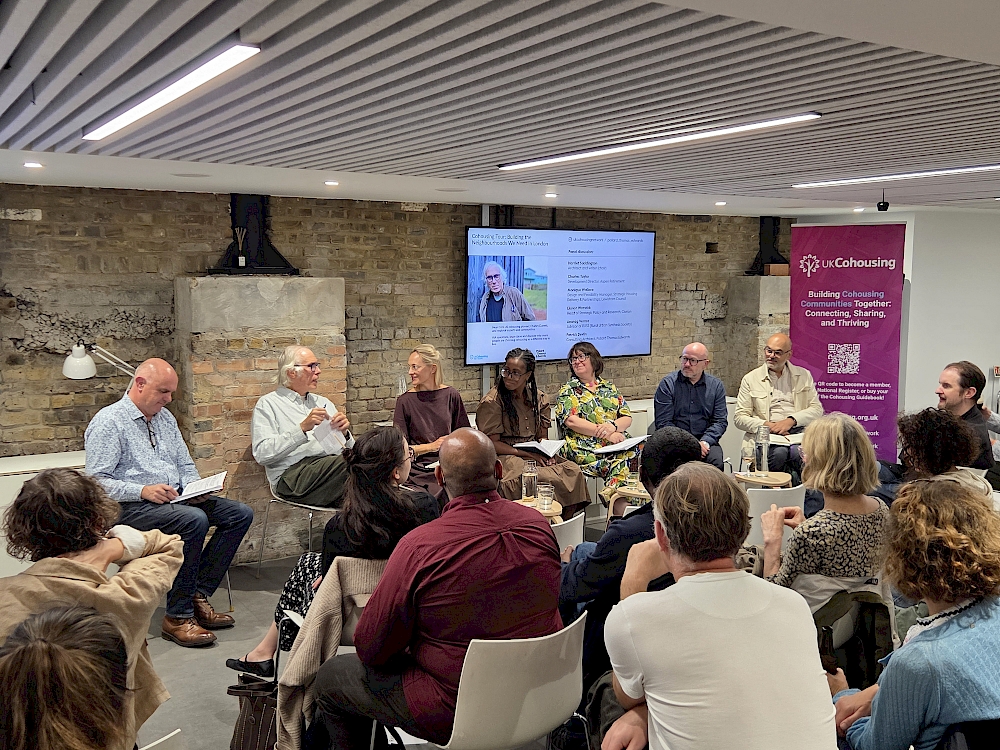
Chaired by architect and writer Harriet Saddington, the panel brought together Charles Taylor, Development Director at Aspen Retirement; Monique Wallace, Design and Feasibility Manager at Lewisham Council; Elanor Warwick, Head of Strategic Policy and Research at Clarion; Anurag Verma, Strategic Advisor to Rural Urban Synthesis Society (RUSS); Patrick Devlin, Consulting Architect at Pollard Thomas Edwards, and Charles Durrett. Each considered what must change if the principles of cohousing are to influence mainstream housing delivery.
From a developer’s perspective, Charles Taylor described a model in which Aspen Retirement takes responsibility for development risk while working collaboratively with the future residents who will ultimately take over the freehold.
“We take significant risk as the developer, but cohousing only works because the group is equally committed to the process. We do the planning, work closely together, and surround ourselves with people who know what they’re doing.”
He suggested that this hybrid approach could combine the pace, financing and expertise of a professional developer with the resident ownership and participation at the heart of cohousing. With an ageing population and many people living in homes that no longer meet their needs, he described cohousing as “the best-kept secret”.
“There’s a whole load of people out there who are ageing in inappropriate homes that aren’t suited and fit for purpose. The market’s not responding to their needs.”
Councils as enablers
Monique Wallace focused on the role local authorities can play in helping community-led projects navigate complex systems. She highlighted the importance of early engagement with planning officers, council members and local communities, rather than presenting a completed proposal and waiting for a response.
Drawing on Lewisham Council’s history of supporting community-led housing, she outlined work to give groups a clearer point of contact within the council, explore local development orders that could reduce planning risk, and identify overlooked opportunities across public and privately owned land.
“If we help you deliver this type of housing, we’re helping ourselves. It’s reciprocated.”
She also warned that the case for cohousing must connect its wider social value to the immediate pressures faced by councils. Projects need to demonstrate what housing need they address, whether they can help release underoccupied homes, how they use constrained sites and what they contribute alongside the number of homes delivered.
Learning from how residents use space
Elanor Warwick reflected on what mainstream housing providers can learn from cohousing, even when schemes are not delivered through a formal cohousing model.
Her experience of post-occupancy research showed that residents often create their own social agreements around courtyards, gardens, balconies and other shared spaces. Rather than treating this activity as something to control, housing providers should pay closer attention to the places where everyday encounters naturally happen.
“Those little encounter spaces, those ‘bump’ spaces where you come together, are the sort of places, as good designers, we should be providing as standard.”
A communal room alone does not create community. Routes through a development, decks, gardens, entrances and even recycling areas can become important social infrastructure when they are designed around people’s everyday lives.
Agency, stewardship and long-term affordability
Anurag Verma brought the perspective of the Rural Urban Synthesis Society, a community land trust behind Church Grove in Lewisham. He described a model based not on common ownership, but on “ownership for the common good”, with the land stewarded to protect affordability over the long term.
“If you give people agency, they will generally not disappoint.”
For Anurag, security of tenure gives people the confidence to contribute to their neighbourhood. Co-designing, co-developing and participating in construction can create a deeper understanding of how homes and shared spaces work, while flexibility allows the community to respond as households and residents’ needs change.
“Once people are secure, that releases them to use the land and the community spaces in the way they want.”
Privacy as the foundation of community
Patrick Devlin drew together four recurring design lessons: the importance of shared space, good daylight without overheating, interaction with nature, and a sense of ownership that extends beyond the legal title to a home.
Using New Ground Cohousing as an example, he explained that community depends on residents having control over when and how they interact. A person should be able to see whether something is happening in a shared space without feeling obliged to join it.
“Living as a community depends on people having secure private spaces.”
At New Ground Cohousing, balconies overlooking the communal garden have evolved into what Patrick described as a “three-dimensional living room”. Residents can talk across the space, retreat behind planting or sit further inside their homes, choosing their preferred level of interaction.
“Helping to generate different kinds of formal and informal places to meet and be, based on a foundation of secure privacy, is one of the key lessons.”

Building the evidence and the examples
The discussion returned repeatedly to the challenge of scaling up. Participants identified access to land, finance, planning, organisational capacity and the length of the development process as persistent barriers. But they also argued that community participation could help de-risk projects by building local support, bringing future residents into the planning process and creating committed advocates for a scheme.
Durrett cautioned against searching for a single shortcut. Growth, he argued, must come through a succession of well-designed and demonstrably successful neighbourhoods.
“How do we scale up? I would argue it’s one step at a time, very deliberately. Build great models.”
His closing point captured both the ambition of the evening and the practical work still required. Cohousing will become more widely accepted when projects provide convincing, visible evidence that they work, socially, environmentally and financially. (The best resource written specifically for architects is the book Cohousing Communities. It was written because of too many failed projects in the USA. Design can mean the difference a project succeeding or failing in the long term or even in the short term.)
“Build the first one perfectly so you can take a thousand photographs of it and say: honestly, this worked. Let’s do that again.”
The evening demonstrated that cohousing is about far more than a shared building or communal room. It is a process through which residents, designers, authorities and developers create the physical and social conditions for a neighbourhood to flourish. The larger opportunity is to take those lessons into housing more widely, creating places that give people privacy and security while making connection, cooperation and mutual support part of everyday life.
About the UK Cohousing Network
The UK Cohousing Network supports people at every stage of the cohousing journey, advocating nationally for the conditions that make cohousing possible, and connecting communities with the tools and peers they need to thrive. Find out more on their website https://cohousing.org.uk/